Discover our Top 20 Jewellery and Watch Website Designs of 2026, featuring inspiring luxury brands, exceptional photography, creative ecommerce design and standout websites from across the jewellery and watch industry.
Read More
How to write a blog post that people can actually find
A practical guide to writing useful blog posts for your jewellery business.
You’ve spent hours writing a blog post, found the perfect images and finally hit publish. Then… not much happens.
The problem usually isn’t that blogging doesn’t work. It’s that a good blog post needs more than a good idea. It needs to answer something your customers genuinely care about, be easy to find and give them a reason to keep reading.
For jewellery businesses, that creates a real opportunity. The questions your customers ask you every day, about diamonds, gemstones, watches, repairs, valuations or choosing the right piece, can become genuinely useful content that demonstrates your expertise and brings the right people to your website.
This guide takes you through the process, from choosing what to write about and researching the subject to structuring, optimising and publishing your article.
Follow these steps each time you write and you'll give every post a much better chance of being found, read and remembered.
1. Define the blog purpose
Before you start writing, decide what you actually want your blog to achieve.
Are you trying to answer common customer questions? Share your expertise? Help someone make a buying decision? Attract new customers? Promote a particular service or collection?
Your blog doesn't need to have just one purpose, but knowing what you want it to achieve will help you decide what to write about and who you're writing it for.
For a jewellery business, some of the best subjects are often already right in front of you. Think about the questions customers ask in your shop, over the phone, by email or before making a purchase. If customers regularly ask you something, there's a good chance other people are looking for the same information online.
The important thing is to start with the customer rather than simply writing because you feel your website needs more content. A blog isn't something every jewellery business has to have. If you don't have the time, knowledge or interest to create genuinely useful content, focus your attention elsewhere. There are plenty of other ways to improve your website and attract customers.
And if your last blog post was published three years ago, consider hiding the blog altogether. There's nothing quite like an abandoned blog to make an otherwise active business look like nobody's been home for a while.
2. Create a title people want to click
Your blog title has one job: make the right person want to read the article.
It should be clear enough that someone immediately understands what the post is about, but interesting enough to make them want to know more. Clever titles can be fun, but clarity normally wins.
Think about why someone would read the article in the first place. Are they trying to solve a problem, answer a question, compare two options or make a buying decision? Your title should make it obvious that the answer is inside.
For example, rather than:
Diamond Clarity Explained
you might write:
Why Diamond Clarity Is Often Overlooked When Choosing a Diamond
The second title still makes the subject clear, but gives you a reason to click. Why is clarity overlooked? Does it matter more than you thought? Are you overlooking it yourself?
One resource I’ve genuinely found useful is Jon Morrow’s free 52 Headline Hacks ebook from Smart Blogger.
Jon opens with a great line:
“The best writers are the best thieves.”
He’s not suggesting you copy someone else’s work. The point is that successful headline structures have been used and adapted by writers for decades. You can look at what already grabs your attention, understand why it works, then apply the same thinking to your own subject.
For example, a headline such as:
The 5 Biggest Mistakes People Make When Buying an Engagement Ring
could inspire:
The 5 Biggest Mistakes People Make When Choosing a Wedding Ring
Same proven structure. Completely different article.
If you struggle with titles, 52 Headline Hacks is well worth downloading and keeping nearby. I’ve used it myself and still think it’s a great little resource.
Stuck for something to write about?
If the problem isn’t the title but the subject itself, we’ve put together 20 Blog Ideas for Your Jewellery Website.
It’s designed specifically for jewellery businesses that need a little inspiration and gives you practical article ideas you can adapt for your own customers.
3. Create a simple outline
Before you start writing, spend five or ten minutes planning what you want the article to cover. It doesn't need to be complicated.
Start by writing down the main questions you want to answer or the points you want to make. Then put them into an order that makes sense to someone who knows nothing about the subject.
For example, if you're writing The 5 Biggest Mistakes People Make When Buying an Engagement Ring, your outline might simply be:
Setting a budget before understanding your options
Focusing on carat weight alone
Not considering how the ring will be worn
Guessing the ring size
Leaving it until the last minute
That's your article planned. You now have five useful sections to write rather than staring at a blank page wondering where to start.
Add a short introduction that explains what the article will help with, then finish with a conclusion that brings the important points together and gives the reader a sensible next step.
Your plan doesn't have to be perfect. You can change it as you write. Its job is simply to give you enough structure to get started and keep the article focused.
4. Should I use AI to write my blog posts?
Yes, but use it as an assistant, not the author.
AI is brilliant for helping you turn an idea into an outline, organising your thoughts, suggesting questions you might have missed or improving something you've already written.
Where it becomes less useful is when you ask it to simply “write me a 1,000-word article about engagement rings” and publish whatever comes back.
AI doesn't have the conversations you have with customers. It hasn't spent 20 years repairing jewellery, compared diamonds under a loupe or helped somebody choose an engagement ring. That's the interesting bit.
Give AI your knowledge, opinions, examples and experience, then use it to help you communicate them more clearly. And always check the finished article yourself. AI can confidently get facts wrong, misunderstand your business or produce something that sounds perfectly plausible but says very little.
What does Google think about AI-written content?
Google isn't telling businesses not to use AI to create content. Its focus is on why the content exists and whether it adds value.
Using AI to help create a genuinely useful article isn't the problem. Producing large amounts of generic, unoriginal content simply to attract search traffic can be.
That's another good reason to bring your own experience, knowledge, photography and opinions into what you publish. AI can help you create the content, but you still need to give people something worth finding.
The aim isn't to prove that a human wrote every word. It's to make sure the finished article contains something genuinely worth reading.
5. Do your research
Even when you know your subject well, a little research can make a good article much better.
Start by seeing what's already out there. Search for your subject, look at the questions people are asking and read some of the articles that already appear. This isn't about copying them. You're looking for what's useful, what's missing and where your own experience can add something better.
Then check your facts. If you're quoting statistics, specifications, regulations or technical information, go back to a reliable source rather than repeating something you've read elsewhere.
For a jewellery business, your own experience is also part of the research. Speak to the people in your business. Ask your goldsmith, watchmaker or sales team what customers regularly misunderstand. Look through emails and enquiries for questions that keep coming up.
You might discover that the most useful part of your article isn't something you found online at all.
Where another website, study or organisation has contributed something useful, credit it and link to the original source. It gives readers somewhere to explore the subject further and helps demonstrate where your information has come from.
Good research isn't about making your article longer. It's about making it more useful, accurate and difficult for somebody else to simply replicate.
6. Write your blog post
You've chosen your subject, planned the article and done your research. Now you can actually write it.
Start with an introduction that tells the reader what the article is about and, more importantly, why it's worth their time. Then work through the outline you created earlier, using a clear heading for each main point or question.
Keep paragraphs relatively short and use straightforward language. Most people won't read every word of an article from beginning to end. They'll scan it first, so headings, lists, images and short paragraphs make it much easier to find what they're looking for.
Don't worry about hitting a particular word count either. Your article should be as long as it needs to be and no longer. A useful 600-word article is better than a 1,500-word article padded with information nobody needs.
Write for your customer rather than trying to impress Google. Use the terminology your customers understand, explain anything they might not, and let your own knowledge and personality come through.
When you've finished, read the whole thing again. Remove repetition, check your spelling and grammar, make sure any facts and links are correct and ask yourself one final question:
If I were the customer who searched for this, would I be happy I'd found it?
Before you hit publish..
We've created an Ultimate Blog Post Checklist for Jewellers covering the things worth checking before your next article goes live.
7. Find your writing tone
How you say something can be just as important as what you say.
Your blog should sound like your business. If customers know you for being friendly and approachable in your shop, your articles shouldn't suddenly sound like they've been written by a university professor. Equally, if you're a high-end fine jewellery brand, an overly casual or jokey tone might not feel right either.
Think about how you would explain the subject to a customer sitting in front of you. The words you'd use, the questions you'd ask and the examples you'd give are often a very good starting point for how you should write.
Your tone can change slightly depending on the subject too. An article about choosing an engagement ring might be warm and reassuring, while advice about jewellery insurance or valuations may need to be more factual and precise.
But don't confuse professional with formal. You can demonstrate considerable expertise without using complicated language or sounding like a textbook.
Most importantly, be consistent. Whether somebody is reading your website, an email, an Instagram post or one of your articles, it should feel like it's coming from the same business.
If you're struggling, read what you've written out loud. If it doesn't sound like something you'd ever actually say to a customer, rewrite it.
8. Your experience counts
One of the biggest advantages you have when writing about your business is your own experience.
If you've spent years selling diamonds, repairing watches, designing bespoke jewellery or valuing antique pieces, you know things that somebody researching the subject from behind a desk simply doesn't.
Use that knowledge.
Share examples. Explain things customers commonly misunderstand. Give your opinion when it's useful. Talk about what you've learned from doing the job. If you're writing about something another member of your team knows better, ask them.
You don't need to keep telling people you're an expert. Demonstrate it through the quality of the information you give them.
For example, instead of simply explaining the difference between platinum and white gold, you might explain which you'd recommend for different customers and why. If you're writing about watch servicing, include something your watchmaker regularly sees when watches arrive in the workshop.
This kind of first-hand knowledge makes an article more useful to your customers and much harder for another website to replicate.
It also gives search engines and AI systems more context about your business, what you know and the subjects you're genuinely experienced in.
Don't write just to demonstrate authority. Write something useful that shows your expertise naturally.
8. Give your reader a next step
If someone has made it to the end of your article, don't just leave them there. Give them somewhere useful to go next.
That doesn't mean every blog post needs a big BUY NOW button. The right next step depends on what they've just been reading.
If you've written about choosing an engagement ring, you might invite them to book an appointment or browse your engagement rings. An article about jewellery repairs could link to your repair service. A guide to caring for jewellery might point them towards another useful article.
You could also invite someone to join your mailing list, download a guide, get in touch or visit your shop.
The important thing is that the next step feels relevant to the article. Someone who has just spent five minutes reading your advice has already shown an interest in that subject, so make it easy for them to continue.
And don't feel you have to wait until the very end. If there's a genuinely useful place to link to a product, service or another article while you're writing, do it.
A good call to action isn't about pushing someone to buy. It's about helping them decide what to do next.

Before you hit publish
You've done the hard work. Before your article goes live, run through these final checks to make sure you've covered the important bits.
LET'S RECAP
✓
Your final blog post checklist
- Start with a useful topic your customers genuinely care about
- Create a title that makes it clear why the article is worth reading
- Plan a simple outline of the main points you want to cover
- Use AI as an assistant, not a replacement for your own knowledge
- Research the subject properly and check your facts
- Write for people first, keeping your article clear and easy to read
- Add your own experience, opinions and real examples
- Give your reader a useful next step when they've finished reading

Want something you can keep?

15 Marketing Ideas for Jewellery Businesses
Looking for new ways to market your jewellery business?
You don't need to be everywhere or constantly chase the latest marketing trend.
Some of the most effective ideas are surprisingly simple: improving how you communicate with existing customers, creating better content, working with other local businesses or simply making more of the products and expertise you already have.
Here are 15 practical marketing ideas you can try, adapt or use as inspiration. You don't need to do all of them. Pick the ones that make sense for your business and start there.
1. Turn what you know into useful content
Your jewellery business probably has far more useful content than you realise.
Think about the questions customers ask every day. How do I choose a diamond? What's the difference between platinum and white gold? Can this ring be resized? How often should my watch be serviced? What happens during a jewellery valuation?
Every one of those questions is an opportunity to create something useful.
And it doesn't all have to be a blog post. Improve your collection pages with buying advice or the story behind a collection. Add better descriptions, specifications, videos, reviews and useful details to your product pages. Create clear guides explaining services such as repairs, valuations or bespoke design.
Then use your blog or education centre for subjects that deserve a more detailed answer.
The aim isn't to create content for the sake of having more pages on your website. Create something because it helps a potential customer understand a product, answer a question or make a decision.
Useful content also gives search engines and AI systems more information about your business, products and expertise, increasing the opportunities for your business to be discovered.
If you're ready to start writing, our guide to how to write a blog post that people can actually find takes you through the whole process.
2. Make it easier for people to find you
Having a great website isn't much use if nobody can find it.
Search engines are still an important way customers discover jewellery businesses, but people are increasingly finding products, recommendations and answers through maps, social media, shopping results and AI tools too.
You don't need to understand every technical detail of SEO to improve your chances of being found.
Start with the basics. Make it really clear what you sell, what services you offer, where you're based and why somebody should choose you. A search engine shouldn't have to work out that you're a bespoke jeweller in Bristol or that you repair luxury watches in Manchester.
Use the words your customers actually use. A customer may search for “engagement rings in Winchester”, “jewellery repairs near me” or ask an AI assistant “where can I get my Rolex serviced in Essex?” Your website needs useful, relevant information that helps answer those kinds of searches.
Make sure important products, collections and services have their own useful pages rather than trying to squeeze everything onto your homepage. Keep your contact details, opening hours, delivery information, returns and other important information easy to find.
And give people reasons to mention and link to your business elsewhere. Local press, suppliers, jewellery organisations, events, stockists and complementary businesses can all help more people discover you.
If you want to dig a little deeper into the search side of things, our Shopify SEO Guide explains the practical steps you can take to improve how your Shopify website performs in search results.
You don't need to become an SEO expert. You need to make it easy for customers, search engines and AI tools to understand who you are, what you offer and why you're relevant.
3. Don't forget what's on your doorstep
It's easy to become focused on reaching customers across the country, or even around the world, and forget about the people living a few miles away.
For jewellery businesses, local customers can be incredibly valuable. They can visit your shop or showroom, book appointments, recommend you to friends and family and come back for repairs, servicing, valuations, gifts and future purchases.
If you have a physical store, make sure you're visible locally. Keep your Google Business Profile up to date, get involved with local events, support other independent businesses and look for opportunities to collaborate. A bridal boutique, wedding venue, photographer or local luxury business may share exactly the type of customers you're trying to reach.
You can also create genuinely useful local content. Talk about events you're involved with, introduce your team, share stories about your area or create useful guides that naturally connect your business with where you're based.
And you don't necessarily need a shop. An online jewellery business can still build relationships locally through events, pop-ups, collaborations, local press and other businesses.
You don't have to choose between being a local business and reaching a wider audience. Sometimes the best opportunities for growth are already on your doorstep.
4. Reward loyalty and referrals
Your existing customers are often your easiest people to market to.
Someone who has already bought from you knows your business, trusts you and may come back for an anniversary, birthday, repair, valuation, wedding ring or another special occasion.
Give them a reason to return.
That could be a small thank-you gift, early access to a new collection, a private event, complimentary cleaning or servicing, or simply remembering important dates and following up well.
Referrals matter too. Jewellery is a business built heavily on trust, and a recommendation from a friend or family member can be far more persuasive than an advert.
You don't necessarily need a complicated loyalty scheme or points system. For many independent jewellers, a personal approach will work better.
Think about what you could offer that feels valuable without simply discounting everything. The aim is to make good customers feel appreciated and give them a reason to talk about you.
5. Make it easy to get an answer
Jewellery customers often have questions before they're ready to buy. Is this ring available in another size? Can I book an appointment? How long does resizing take? Do you offer valuations? Can I collect from your store?
Make it easy for them to get an answer, but don't assume that means somebody needs to sit watching live chat all day.
A good FAQ or help section can answer many common questions immediately. Modern chat tools can also use information from your website or knowledge base to answer straightforward questions when your team isn't available.
Used well, AI chat can be genuinely helpful. It can point someone towards your delivery information, explain how to book an appointment or help them find the right service without requiring a member of staff every time.
But automation should make customer service easier, not become a barrier to it.
Always give customers a clear way to contact a real person. If the chat can't answer the question, let them send a message, email, call or request a callback rather than trapping them in an endless automated conversation.
For smaller businesses, even a simple contact form with a clear message such as “We're usually back to you within one working day” can be better customer service than offering live chat you rarely have time to answer.
The aim isn't to be available every second of the day. It's to make sure customers always know how to get the help they need.
6. Don't forget about email
Email marketing might not be the newest marketing channel, but it's still one of the most useful.
Every person who joins your mailing list has given you permission to contact them. Unlike a social media following, you're not relying on an algorithm deciding whether your customers should see what you publish.
For a jewellery business, that gives you plenty to talk about. New collections, recently arrived watches, gift ideas, events, buying guides, behind-the-scenes stories, useful advice, customer stories and occasional offers can all give somebody a reason to come back.
Start by making it easy to join your list. Add a signup form somewhere obvious on your website and consider a well-timed pop-up if it suits your brand. Give people a reason to subscribe too. That doesn't necessarily have to be 10% off. Early access to new pieces, invitations to events or genuinely useful content can be just as relevant.
Then actually use the list.
You don't need to email customers every week or create an elaborate newsletter. One useful email sent regularly is better than building a list of thousands of people you never speak to.
Pay attention to what people respond to. Which emails generate clicks, enquiries or sales? Which subjects get ignored? Over time, you'll get a much better understanding of what your customers actually want to hear from you about.
And remember that not every email has to sell something. Staying useful and interesting between purchases gives customers a reason to remember you when the next anniversary, birthday, engagement or special occasion comes around.
You've already worked hard to earn these customers and subscribers. Don't make yourself start from zero every time you want to market something.
7. Consider SMS marketing
Email isn't the only way to keep in touch with customers. For the right business, SMS can be a useful addition too.
A text message is immediate and difficult to miss, which makes SMS particularly useful when you have something timely or genuinely worthwhile to say.
For a jewellery business, that might be early access to a sale, the arrival of a sought-after watch, an invitation to an event, an appointment reminder or a limited collection becoming available.
But use it sparingly.
A customer's mobile number can feel much more personal than their email address. Sending too many messages, or sending texts that aren't particularly useful, can quickly become annoying.
You also need to make sure you have the appropriate permission to contact people by text and provide an easy way for them to opt out. Don't assume that because somebody gave you their mobile number when placing an order, you can automatically use it for marketing. The ICO provides current guidance on the rules around SMS and other direct marketing.
ICO guidance on electronic marketing
If SMS feels appropriate for your business, start small. Most ecommerce and marketing platforms can help you collect the right permissions, manage subscribers and send campaigns.
Think of SMS as something to use when you have a particularly good reason to contact somebody, not simply another channel you need to fill.
8. Sell where customers are already shopping
Your own website should remain the centre of your business, but it doesn't have to be the only place you sell.
Marketplaces such as Etsy, eBay and Amazon already have enormous audiences actively searching for products. Newer channels such as TikTok Shop have also made it easier for brands to put products directly in front of customers while they're discovering content.
For the right jewellery business, that can be a powerful shortcut.
Rather than relying entirely on people finding your website, you're putting selected products in places where customers are already browsing and ready to buy.
Etsy can work particularly well for personalised, handmade and design-led jewellery. eBay may suit pre-owned watches, jewellery and collectables. TikTok Shop can make sense for more accessible or trend-led products where video and social discovery play a big part in the sale.
The important thing is not to list everything everywhere.
Choose the marketplaces that fit your products, margins and customers, then use them strategically. A marketplace might introduce somebody to your brand for the first time, while your own website gives them the fuller story, wider collection and reason to come back.
Think of marketplaces as additional shop windows, not replacements for your own website.
9. ★ Remember the important dates
Life's important moments and Jewellery naturally go together. Birthdays, anniversaries, weddings and other milestones all give customers a reason to celebrate, and potentially a reason to come back to you.
But don't make every communication an excuse to sell something.
A handwritten birthday card, anniversary message, complimentary jewellery clean or small unexpected gift can be far more memorable than another discount code.
I still remember Costa giving me a free piece of cake on my birthday when most of the other coffee shops I used did nothing. I'm mentioning it here years later, which rather proves the point.
For jewellers, there's an even bigger opportunity because you may already know some of these important dates. If you've helped somebody choose an engagement ring or wedding rings, for example, you potentially have a relationship that could continue through anniversaries, birthdays and other occasions for years to come.
Used appropriately, your customer records or CRM can help you remember those moments without somebody having to keep everything in their head.
The aim isn't to turn somebody's anniversary into a marketing campaign. It's to show that you remembered.
10. Make your products discoverable on social media
People don't only use social media to keep up with friends anymore. They use it to discover products, research businesses, watch reviews, find inspiration and decide what they might buy next.
For jewellery businesses, that creates an obvious opportunity. Jewellery is visual, interesting and often has a story behind it.
But you don't need to be active on every social platform.
Choose the places that suit your products and customers. Instagram might be perfect for showcasing new pieces and behind-the-scenes content. TikTok can work well for demonstrations, transformations and short educational videos. Pinterest can be particularly relevant when people are researching weddings, engagement rings and gifts. YouTube gives you more space to explain products, expertise and services in depth.
Where the platform allows it, connect your product catalogue or tag products so somebody who discovers something they like has an easy route to find out more or buy it.
If you want to explore this further, we've also looked at why live social shopping is changing retail and what it could mean for luxury brands.
And remember that social media doesn't always need to produce the sale itself. Someone might discover you on Instagram today, visit your website next week and walk into your shop three months later.
The important thing is to make the journey between discovering your business and finding out more as easy as possible.
Don't try to be everywhere. Be useful and visible in the places your customers actually spend their time.

11. ★ Get your customers to tell the story
Some of the best marketing content won't come from you at all. It will come from your customers.
Photos, reviews, proposals, weddings, anniversary stories and real experiences can give potential customers something your own marketing often can't: proof that other people have trusted you and been happy with the result.
A great example is The True Gem, which built its Love Stories around real customer submissions. Instead of simply showing engagement rings, they show the people, proposals and stories behind them. That makes the jewellery feel more personal and gives future customers something to relate to.
For a jewellery business, this kind of content can be incredibly powerful.
Ask customers if they'd be happy to share a photo after a proposal, wedding or special occasion. Feature the best stories on your website. Include customer photos in emails. Share reviews and real-life images on social media. If you create bespoke jewellery, show the finished piece alongside the story behind why it was made.
But don't expect this content to appear automatically.
You'll usually need to ask for it, make it easy to submit and follow up with customers at the right moment. You may also need permission before publishing photographs or personal stories.
And don't feel you need hundreds of submissions. Ten genuinely good customer stories can be far more valuable than hundreds of generic social posts.
This is one of the harder ideas in this list to do well, but that can also be its advantage. Most businesses won't make the effort.
The best marketing often comes from doing the things your competitors can't be bothered to do consistently.
12. Start caring
It sounds obvious, but it is surprisingly easy to lose sight of.
Behind every order, enquiry, repair, complaint or appointment is a person choosing to spend their money with you rather than somebody else.
That deserves some care.
Great customer service isn't just about being polite when everything goes smoothly. It is about how you respond when something goes wrong, when a customer is disappointed, when an order is late or when somebody simply needs a little more help than expected.
Mistakes happen. What people often remember most is how you dealt with them.
Be kind. Be helpful. Be honest. Reply properly. Keep people informed. Take responsibility when you need to. And don't make customers fight to get an answer.
For jewellery businesses, this matters even more because many purchases are emotional, expensive or connected to important moments in somebody's life.
A customer who feels looked after is more likely to come back, recommend you and trust you again in the future. But even that shouldn't be the only reason to care.
Not every good decision needs to be measured by whether it increases this month's revenue. Sometimes looking after people properly is simply the right way to run a business.
And over time, that usually creates the kind of reputation, loyalty and word of mouth that businesses spend a fortune trying to manufacture.
13. Don't forget the upsell
Sometimes increasing sales doesn't mean finding more customers. It means making a little more from the customers who are already buying from you.
And an upsell doesn't need to be complicated.
If somebody is buying a watch, could you offer a watch roll, cleaning kit or insurance? If they're buying jewellery as a gift, could you offer premium gift wrapping? If they're buying an engagement ring, could you introduce wedding rings, insurance or an annual care service?
Look for things that naturally complement the purchase rather than simply trying to add something else to the basket.
Your website can do some of this automatically. Related products, bundles, cart recommendations and post-purchase offers can all introduce relevant extras at the right moment.
But don't forget the opportunities offline either. A member of staff simply asking “Would you like us to gift wrap that?” can be just as effective.
The important thing is that the upsell should make sense.
Nobody wants to feel as though they're being squeezed for another £50 at the checkout. A good upsell makes the original purchase better, easier or more complete.
And small additions can quickly add up. If you already have hundreds or thousands of customers buying from you, you don't necessarily need a huge increase in average order value to make a meaningful difference.
14. ★ Let customers try before they buy
Buying an engagement ring or wedding ring online can be difficult. Photographs and videos help, but sometimes customers simply want to see how different styles look and feel on their hand.
A try-at-home service can remove that barrier.
Create a small collection of sample rings using lower-cost materials, such as silver settings with CZ or moissanite stones, and allow customers to choose two or three designs to try at home before committing to the real thing.
You could charge a refundable deposit or small fee for the service and include secure tracked return packaging to make sending the samples back straightforward.
We've helped jewellery businesses introduce this type of service and one of the most interesting things happens before the customer even places their final order.
It changes the conversation.
Instead of a customer browsing dozens of rings online and asking “How much is this one?”, you've already started a conversation about “Which of these three do you prefer?”
They've experienced your service, handled your designs and started narrowing down what they actually want. You also have an opportunity to follow up, answer questions and help them make their decision.
You could offer to credit the cost of the service against a subsequent purchase, but the experience itself should be useful enough to have value.
It won't be appropriate for every jewellery business, and setting it up properly takes more effort than adding another advert or social post.
But that's also why relatively few businesses do it. Sometimes the more difficult marketing ideas are the ones that create the biggest advantage.
15. Read the signs
I regularly drive up the M42 and M5 towards Birmingham. On the journey there's a huge billboard advertising a well-known jeweller in the Jewellery Quarter.
It's always there. And I always notice it.
Think about the tens of thousands of people who drive past that sign every day. Most aren't looking for jewellery at that particular moment, but every time they see it, the name becomes a little more familiar.
Then one day they need an engagement ring, visit the Jewellery Quarter or hear somebody mention the business and think, “I know that name.”
That's the power of visibility.
Marketing doesn't always need somebody to click something, fill in a form or buy immediately. Sometimes you're simply making sure people know you exist.
Billboards are an obvious example, but the same principle applies to local advertising spaces, sponsorship, event signage, train stations, shopping centres, sports clubs and anywhere else your potential customers regularly spend time.
You don't necessarily need the biggest billboard on the M42 either. A smaller, well-positioned advertising space that you use consistently could be far more valuable than constantly trying different things.
Sometimes being seen in the same place, again and again, is exactly what makes a brand memorable.
What should I concentrate on first?
If you've reached the end of this article wondering which of these 15 ideas you should actually do, don't try to do all of them.
Start by looking at what you already have.
If you have lots of existing customers but rarely contact them, start with email. If customers regularly ask the same questions, turn those answers into useful content. If people visit your product pages but don't buy, look at the buying experience, customer reviews and simple upsells. If most of your customers are local, concentrate on becoming better known locally.
If you're starting from scratch and have more time than money, useful content is still one of the best places to begin.
Write about what you know. Answer the questions customers ask you every day. Explain your products and services properly. Share your experience and give people useful information that helps them make a decision.
You don't need to publish something every week. One genuinely useful article, guide or improved page each month will give you something valuable to build on over time.
We've created a separate guide to writing blog posts people can actually find if that's where you decide to start.
The important thing is to choose something and actually do it. A simple idea implemented properly will achieve far more than 15 ideas sitting on a to-do list.

5 Ways to Improve Your Jewellery Website
Where should you start?
If your jewellery website isn't generating the sales, enquiries or traffic you expected, it can be difficult to know what to work on first.
SEO, content, social media, advertising, email, website design; there's no shortage of advice telling you what you should be doing.
But you don't need to do everything.
Here are five practical areas I'd look at first to improve your website and give it a better chance of attracting and converting customers.
“Digital growth isn't about doing everything. It's about identifying the things that will make the biggest difference and doing those well.”
Steve Irvine - CEO Lionsorbet
1. Keyword Research
Before you start any type of content marketing strategy, it’s a wise idea to understand two imperative questions about your online business;
What are potential customers searching for or asking online when looking for my products, services and expertise; whether that's through Google, AI assistants or other discovery platforms?
Who are my most significant competitors, and which searches, questions and topics are they already visible for?
Think of your keyword strategy as the ingredients for baking a cake. Producing the desired results needs research, time, energy and strategy. To get started, let's look at a few free online tools you can take advantage of, including:
Ubersuggest - https://app.neilpatel.com/
Put your domain name into the Ubersuggest search bar and view all the results. For instance, check what keywords your domain is already ranking for. Alternatively, type in your competitor's domain name and revise their keywords. What are they ranking for? Start creating a keyword list for your website.
Google Trends - https://trends.google.com/trends
Google Trends is an innovative online tool that lets you get an insight into what people are searching for now! Type in a search term or topic that's relevant to your business and view the results. Compare topics, review interests over time and look at related topics. You should be able to map out more keywords and subjects for your keyword research list.
Google Search - https://www.google.co.uk/
The Google search bar comes with plenty of benefits for keyword strategy ideas. Type a topic, service or product into Google Search, scroll to the bottom of the page, and look for the heading Related Searches. Google will show you a selection of alternative user searchers for keyword research. Jot these phrases, subjects, services and alternative products on your list. Google is potentially showing you more accessible search terms and keywords to rank high for.
Google Keyword Planner - https://ads.google.com/
The Google keyword planner allows you to search and plan keywords for your targeted industry sector. You can discover new keywords or look at search volume forecasts for an expected return on investment (ROI). The best feature of the Google keyword planner is that it shows you how much each keyword is worth through pay-per-click campaigns (PPC).
By now, you should have all the correct ingredients (keywords, subjects, topics and ideas) to help you rank your website through search.
WHAT TO DO
✓
Find out what your customers are searching for
Identify the products, services and questions your customers actually search for, then use those insights to decide which pages and content are worth creating or improving.
2. Content Strategy
Looking at the keyword list, you have researched and created, you should have a better understanding of what you want to rank for through user search. Your website can rank high for organic search if developed correctly. Here are a few examples;
Proactively write considered articles for your blog or news feed. These articles need to be helpful, educational, engaging, inspirational, original, and better than the existing content online.
Write FAQ pages to cover important topics where questions are more likely asked in search results than open-ended stements. e.g
What is the size of my ring? How do I clean 18ct Gold?
Where is the best place to get insurance for my high-value items?
When is the best time to buy an engagement ring?
How do I measure the size of my ring for my finger?
Use the keyword strategy within your content creation or write articles around researched subjects, products and services.
Try and make the top-level pages of your business website helpful and easy for customers to understand.
Add infographics, eye-catching imagery, graphics, and video for users to enjoy and learn from.
Write cluster articles around each search term you wish to rank high in Search Engine Results Pages (SERPs). For example, creating a wealth of original articles under one category or subject can show search engines that users will find your website favorable.
When planning content, always try and have a strategy. There needs to be a reason for each article, video, or infographic. Search engines tend to rank web pages high on SERPs if they are helpful for users trying to search for the correct information.
WHAT TO DO
✓
Create content with a clear purpose
Don't publish content simply to keep your website active. Use what your customers are searching for to create useful pages, articles and guides that answer their questions and support the products and services you want to be found for.
3. On-Page SEO
On-page SEO refers to the optimisation of the source code for each webpage. As over 1 billion live websites are on the net, it’s become essential to understand the importance of on-page SEO. Moreover, technical SEO doesn't have to be difficult to understand. You just need to follow a few rules;
Map out any articles with your keyword strategy. Avoid keyword stuffing (the keyword or phrase is littered throughout the text).
If you can edit your content's metadata (title and description), try and optimise the text to drill down on why the article is helpful for searchers. In addition, add your targeted keyword to the metadata description.
When creating cluster articles or having already produced relative copy about the same subject, hyperlink an internal link to that content. Internal link building is essential because it shows search engines you have important information on your website about a particular subject.
If the blog post or article is product or service related, link back (hyperlink some text that mentions the product or service) to that top-level page.
If you have researched your content and need to use external links to tell users about a fact or offer up more information, always link to the source and offer this in the form of an external link.
Most websites have content management systems (CMS) that allow for a source code and visual editor view. The source code will show basic HTML code read by search engines. If you don’t understand HTML code, stick to the visual editor and use the editor tools to structure your article.
WHAT TO DO
✓
Make every important page easy to understand
Give each page a clear title, useful description and logical structure. Link naturally to relevant products, services and supporting content so both customers and search engines can understand what the page is about.
4. Off-Page SEO
Mastering the art of off-site SEO can be a little tricky, especially when trying to gain page rank using a range of techniques. However, if you persevere, put in the time, and give yourself small targets, you might be surprised with the result you can achieve.
What you need to be doing;
Create fantastic content where other website owners link to your content. These are called natural links.
Ask customers and other business owners to link to your website content. This activity is called manually built links and should be used with caution. Abuse of this tactic could result in Google penalising your domain.
You can leave comments, add your business to relevant directories, link on chat forums, and produce press release information for other websites. Self-created links should also be implemented with caution.
Always follow Google's guidelines for gaining backlinks to your domain. Never pay for links, exchange links or use any service where links are not gained naturally.
Having relevant links to your website can signal search engines to increase your website's position through organic search.
A favourable strategy used by many companies to gain leverage with off-page SEO is to focus on brand awareness. Furthermore, to gain authority in your business sector, you need to offer value, and trust, gain positive reviews and feedback or have happy customers sharing your products and services.
To build your brand and gain trust with your products or services, try the following;
Social media marketing
Guest blogging
Linked and unlinked brand mentions
Influencer marketing.
WHAT TO DO
✓
Build authority beyond your own website
Focus on earning genuine mentions, links and recommendations from relevant websites, customers and organisations. Strong content, positive reviews, PR and industry relationships are more valuable than trying to manufacture backlinks.
5. Revise The User Experience (UX) Design
Sometimes, business owners have plenty of traffic pushing through to their domain. However, the conversion for sales or services is unexpectedly low. For example, there could be several reasons for customers disappearing and not returning to your online brand.
The website is on a slow server, or the web pages have not been optimised for speed. Moreover, slow websites can leave customers disappointed, and they could leave quickly.
A website's navigation can sometimes be challenging. Revise the user flow charts in the Google Analytics app. Check where customers are entering and exiting the website. Run through the process and get externals to revise the website.
As all design is subjective, people may be put off by the colour or the website's layout. For instance, does your website need a redesign?
The website is not optimised for mobile phones. Trying to navigate a desktop website on a mobile phone can cause users to leave any domain out of frustration.
The brand may not be reputable or have substantial authority in the industry.
Product or service price points may be too high or too cheap.
The product page may be challenging to use, with drop-down options not being clear.
There could be coding errors on the website, causing the website to break.
Is the payment Application Programming Interface (API) set up correctly, and can customers make a purchase?
The top-level navigation may be too heavy (loaded with products or services), or unnecessary pages are in the wrong place. Place terms, policy, sitemaps, legal and cookies in the footer.
Offer discount codes or a reason for customers to be loyal.
WHAT TO DO
✓
Make it easier for customers to buy
If you're attracting visitors but they aren't becoming customers, look at the experience before chasing more traffic. Check your mobile site, navigation, product pages, speed and checkout, and remove anything that makes buying unnecessarily difficult.
Focus on what will make the biggest difference
You don't need to tackle everything at once. Start by understanding where the biggest opportunities are, make the changes that are most likely to improve the website, then measure what happens.
If you're not sure where to begin, these are the five areas I'd focus on first.
LET'S RECAP
✓
Five things worth focusing on
- Understand what your customers are searching for
- Create useful content with a clear purpose
- Make your important pages easy to understand
- Build genuine authority and reputation
- Remove friction from the customer experience

Ecommerce Marketing for Jewellers: A Practical Guide
Whether you have a newly launched store or an existing retail website selling products and services online, having an effective marketing plan will allow you to:
Increase traffic to your website
Gain new enquiries for sales opportunities
Generate revenue online via product sales
I would like to say that it’s easy to accomplish with little effort but the reality is running an online business requires a constant, and consistent approach to marketing to continue to achieve sales, grow your business, and increase revenue. Why should I have a plan?
Why should I have a plan?
Having a plan gives you an effective blueprint to build the foundations of your business and keep you focused on the areas that need attention. If you are busy working on too many things at once, you can feel busy but achieving very little and in most cases, spending money with little or no gain. Each area of your marketing plan should be undertaken, tested, adjusted, and repeated to ensure you are getting the very best return on investment.
Understanding your business?
It is vitally important to understand what your business is, why should a customer buy your products, and what your goals and success factors are.
What is my business?
Clearly defining your business is important not just for you and your staff but also for your fans, followers, and newly acquired customers. If you only sell Lab Grown Diamond Engagement Rings, for instance, your content and marketing information need to be clearly focused on this area of business and the reasons why lab-grown is the best choice over mined diamonds. If you sell more cost-effective jewellery such as earrings and pendants to fashion-conscious teens, your messaging needs to be specific to their tastes and searching habits. If your business is being listed on google for general terms like jewellery then you could be marketing to the wrong demographic and thus reducing your visibility because of irrelevant and ill-targeted search listings.
Your business should be clearly defined in a single sentence so that at a glance people understand, Why you do, allowing them to instantly decide if they believe what you believe. This then leads to the How you do what you do and What you do: can you provide what they are looking for? Simon Sinek explains this perfectly in his inspiring Ted Talk the Power of Why.
The Power of Why
“People Don’t buy what you do they buy why you do it”
Simon Sinek
Why should a customer buy my product?
An area often overlooked by many business owners. The easiest way to sell a product is if you have a genuine reason to buy it. Write down 5 reasons why your customers should buy your product. This forms the beginning of your sales message. Some examples include:
It empowers them to take control / take action
It supports their identity. Aligns with their aspirations and means they are part of something bigger.
They provide value and create trust and loyalty.
They provide a new or unparalleled experience. Create joy and memories.
Your products actively support charities, and foundations and create community.
They support an inherent need, creating a sense of satisfaction.
They present a quality that attracts those that value creatiity and craftmanship.
What are my success factors / Goals?
If you understand what your success factors and goals are over the next 2-5 years you can start to plan how that can be achieved. A large team with investors will have completely different goals than a newly formed company with only 2 members of staff. Revenue and growth expectations will be wildly different. Some things to consider and document and revisit and update every three months.
What are my revenue/sales projections for the next 12 months / 24 months and 36 months? How does this relate to average product sales value? Average diamond ring sales are approx £1500.
The average conversion rate for online sales for jewellery is between 0.01 and 0.1% and can be less for high-value products such as engagement rings. How many sales per month would you need to meet your projections above? Conversion rate is defined as the percentage of website visitors that buy something from your site or enquire and buy offline. For instance if you get 10,000 website visitors in 1 month and 12 sales your conversion rate is 12/10,000 = 0.0012%
Knowing how many sales you need per month will define how much traffic you need. For instance, if you need 10 sales per month at a 0.01% conversion rate, you need to get 1000 high-quality visitors to your website to achieve these results. Tracking your conversion rate is important so you can correlate new visitors vs returning visitors vs actual sales or enquiries.
Now that you know how much revenue you want, the number of site visitors you need and the number of sales you need to achieve this you can start to work out how many staff you will need to achieve these goals or how many new team members you will need to support the growth for marketing and sales.
If you are an established business with recurring costs and liabilities. Work backwards. Work out what your total running costs are including staff and work out how many sales per month would support your current business and what increase you would need to achieve your ideal growth over the next 1-5 years.
Your Website
Should you work on your website or your traffic first? Personally, I’d rather have a website that is 80% perfect that can be updated over time and spend time working on obtaining traffic than delaying traffic building to make a perfect website. Even just a delay in one month can set your traffic and potential revenue back a great deal. If your site covers these areas as a priority then you can start working on driving traffic to your website.
Your website should instill confidence and authority leading visitors through your website to browse and buy with ease.
Eye Catching Home-page
Clear contact details including phone number and email address
About page Company Story or History
Clear Navigation, Links to collections, and Products
Simple and clear product pages
High-quality images,
Simple and obvious pricing
Title and reference number/ SKU
Description (add as much detail as possible) and Specification
Ensure you have edited your SEO title and Description for all pages and products to be relevant and descriptive
Testimonials / Case studies or ideally live reviews from Google or Trustpilot
Easy to understand Delivery and Returns Policy
Important: Regularly test your website. Go through the checkout in full to see if there are any blocks in the process, and check enquiry and contact forms to ensure they are delivering the information to your email.
Channels for Effective Marketing
There are three effective ways to attract, build and grow traffic to your website. Pay close attention to each of these areas and you will grow your traffic to your website which should see a surge in enquiries and sales.
Search Engines
Pay Per Click PPC Ads
Organic Search Engine Results
Onsite and Offsite SEO
Link building
Social Media Marketing
Paid Advertisements
Organic Growth and building an audience
Content Marketing
Create unique and original content
Email Marketing
Search Engines
Search gives jewellers an opportunity to reach customers who are actively looking for their products or services.
Someone searching for “diamond engagement rings Birmingham” is showing much stronger buying intent than someone simply browsing social media.
Paid Search & Google Shopping
Google Ads and Shopping can put your products in front of potential customers quickly and can be particularly useful for new businesses, important collections and seasonal campaigns.
But don't judge success by traffic alone.
If you're paying to send customers to weak product or collection pages, increasing your advertising budget may simply increase the amount of money you're wasting.
✓ What should you do?
Start with your most commercially important products or collections. Make sure the pages customers land on are strong, test your advertising and measure whether that traffic actually generates sales or enquiries.
If it works, scale it. If it doesn't, understand why before spending more.
Organic Search Engine Traffic
Organic search can be a fantastic source of relevant, targeted customers. When someone searches for a product, service or question related to your business, search engines aim to show the most useful and relevant results.
Strong product and collection pages, useful guides, detailed service information and genuinely helpful content can all help your website appear for the searches that matter to your customers.
“Your SEO strategy should focus on creating useful, original content, guides and resources that answer the searches and questions relevant to your products and services.”
SEO should be viewed as a long-term part of your marketing strategy. The objective isn't to publish more content than your competitors, but to create better and more useful content where it matters.
Social Media Marketing
Social media is a powerful way to build an audience, followers and fans or build a community of like-minded individuals that become ambassadors of your products and services. Each social platform will have a slightly different user base, e.g Linkedin is typically professional’s browsing during the day and is more business orientated, whereby Facebook is more social with people browsing during their downtime. This can affect how they might interact with your posts or adverts.
Paying for traffic through Social Media
Unlike PPC ads through search engines like google which display ads to customers looking for specific search terms, Social media companies like Facebook and Instagram will post adverts to people within a demographic e.g age, gender, location etc. in the hope that they like what they see or read and interact with the post. Adverts require a daily budget and a specific plan to target a particular set of individuals with your message, product or offer to obtain a result. This may be clicking through your website or signing up for your newsletter. Once you have built up an audience of people who have interacted with your brand you can then re-target these potential customers with reminders or specific offers to convert them into paying customers. It is generally advisable to work with an ad agency or contact the social media team themselves and request some help in setting up your campaigns to achieve a higher return on investment.
Building an Audience through Social Media
Social media can be leveraged in two ways to grow your business, increase website traffic and enquiries about your products and services.
Vanity Metrics: a term used to show a brand with a large following. This value makes you appear more popular and authoritative. This can give high-value signals to potential customers giving confidence and a wow factor. You can grow this figure by setting up ads to target ‘LIKES’ and ‘FOLLOWS’ rather than traffic to your website.
Genuine Engagement: This is the most time-consuming but rewarding part of social media growth. Create regular content for each platform. Connect with your audience on a personal level. Care about the content you are creating and ensure it adds value. Content-based businesses will win over the next 5-10 years so it is important to create a social media content plan that is achievable and affordable.
Content Marketing
Your content marketing plan is important for creating long-term value and authority on your website. If your blog or page posts are consistent, high quality, educational and informative your website will start to rank higher over time as an authority in your industry. This will increase your traffic over time and work harder for you than paid ads. If you are unable to write new content on a regular basis (minimum of 1 post per month) then hire someone to create a content plan and create the content for you. Continuing to forget or leaving it to chance will end up costing you a huge number of potential visitors and customers over time.
Creating Unique and Original Content
Google has a large number of factors it uses to define the relevancy of a piece of content. It is easy to get lost in all these factors. Our advice is to start building original content sooner rather than later. This can be in the form of a blog, new pages or FAQs at bottom of existing collections.
Start creating regular content and publishing them on your website. You can then use this content in many ways
Google indexing for search. Get found on a google search by customers looking for your products and services.
Training guides for staff and customers to understand your products and services better. The more they know the easier it is to impart this knowledge to your customers and create more sales opportunities.
Publish on Instagram, Facebook, Linkedin, and Pinterest to grow your social audience.
Publish on Google my business to increase local search opportunities and add valuable trust signals to your audience
Build authority in your industry as a resource of experience, knowledge, and expertise.
A numbers game: If each good blog post only produces an average of 200 new visitors a month (in some cases we are seeing upwards of 1000-3000 per article), with an average of 2 new articles per month you could be seeing 4800 new visitors per month after a year and 9600 after two years. Compound this with visitors from social media, Google My Business, Review platforms, email marketing, and advertisements and you can see your traffic growing into a healthy source of sales and enquiries for your products.
“For every month you are not writing new content you could be losing 400 potential new visitors. What is the value of that to your business growth over a two-year period? “
TOP TIP: Find out what your competitors are writing by searching google for specific search terms and see what displays the highest in the search results. Study these pages and write a plan and article outline that covers this information in more detail. At the very least produce a similar content guide (be very careful not to copy the content as this can result in being penalized by google). Remember if you don’t have that particular content piece on your website then there is a good chance you won’t be listed in search engines for customers looking for that information.
Email Marketing
Sending out regular emails directly to your customers is one of the simplest and most effective ways to re-engage with them, send specific and directed offers and remind them who you are and how good your products are.
Various studies have shown that for each £1 spent on email marketing the returns can be up to £42 back. Can you afford not to invest in this practice?
Own your own information: Collecting your customer’s email addresses with permission to email them offers is a powerful tool to build and keep safe. No social platform allows this. You can create your audience but you have to pay to get access to 100% of them. It is widely known that social media platforms throttle the number of followers that see your content for free, even though you have paid dearly to acquire them. Start collecting customer names, email addresses and key dates such as DOB or Anniversary. These dates are great for future marketing opportunities.
Create a website Signup form: Most website builders will have tools to allow a signup form to display on your website. A popup can be more effective than one in the footer of the website. Keep it simple and quick to follow. A simple email address will suffice but you can add more details as mentioned above. Entice customers to sign up by offering a discount code that displays after signup. Tools like Mailchimp and Shopify Marketing have this ability built in.
Send Regular Emails: Be consistent with your approach. Once per month or every two weeks or every week. Your loyal customers will begin to look out for them. Keep offers specific and infrequent. Customers may only buy if there is a discount being offered. Use emailers to:
Highlight new products
Send offers and discounts
Create brand awareness
Give insights into company news and information
Outline trade events or open days
Highlight new blogs and website content
Analyse and Repeat
A crucial part of any marketing plan is to analyse and track the data. Understanding the numbers and actual return from your efforts rather than a finger in the air or an "I have a pretty good idea”. Every month track your KPIs such as traffic volume, average order value, ROI and conversion rate for instance to see where you can improve.
LET'S RECAP
✓
Your ecommerce marketing plan
- Understand what your business stands for
- Know why customers should buy from you
- Define your goals and what success looks like
- Improve and optimise your website
- Create useful, original content
- Build and use your email list
- Share and promote your content
Not sure where to focus your marketing budget?
Our Ecommerce Growth Plan identifies the areas we’d prioritise and where we’d invest next.

Shopify SEO: A Practical Guide to Improving Your Store
Shopify gives you a strong technical foundation for ecommerce, but simply launching a good-looking Shopify store doesn't mean customers will find it.
SEO is about making it easier for search engines to understand your website, while creating pages that genuinely help customers find the products, information and answers they're looking for.
Having worked with Shopify stores for many years, I've found that the biggest opportunities are rarely about doing hundreds of tiny SEO tasks. They're usually about getting the important things right: your website structure, collections, products, content and technical setup.
This guide covers the practical Shopify SEO improvements I would look at first.

“A beautiful Shopify store is only useful if the right customers can find it. Good SEO starts with understanding what they're looking for and making sure your website gives them the best possible answer.”
Steve Irvine - CEO Lionsorbet
1. Why Should You Invest In SEO For Shopify?
Investing in SEO on the Shopify platform is a smart move for your business. It is a surefire way to boost your online visibility, attract qualified leads, and achieve long-term success in today's competitive business landscape. SEO allows you to:
Boost Visibility: SEO helps your Shopify store become more visible and discoverable online, driving organic traffic and potential customers to your website.
Gain a Competitive Edge: By optimising product descriptions, meta tags, URLs, and using relevant keywords, you can rank higher in search engine results pages, giving you an advantage over your competitors.
Targeted Marketing: SEO allows you to customise your content and target specific audiences, increasing the chances of attracting qualified leads and improving conversion rates.
Enhance User Experience: A well-executed SEO strategy on Shopify ensures faster loading times, mobile responsiveness, and easy navigation, resulting in a better user experience for your customers.
Encourage Repeat Visits: Satisfied customers are more likely to return. By delivering a positive user experience through SEO, you can increase customer satisfaction and encourage repeat visits to your Shopify store.
Long-term Success: Investing in SEO on the Shopify platform sets your business up for long-term success in the highly competitive digital marketplace, helping you increase online visibility and achieve your business goals.
Shopify has some great features that conform to Google’s search guidelines and whether you’re a novice or seasoned SEO pro there are plenty of ways to enhance your website to build trust and authority, increase search traffic, leading to enquiries and sales.
2. Step by Step SEO Success on Shopify
Let’s cut through all the noise on the internet about Shopify SEO and provide a practical guide to updating your website. When we launch a new store online this is our checklist that we work to and we provide our clients to ensure they have covered all areas. We will explain some of the areas in more detail below but follow these steps to the letter and you’ll be 80% there to SEO success.
Step1: Set your Store Name Correctly
When you set up a store the store name can end up being truncated or abbreviated. This store name is added to the end of all page SEO titles by default
e.g bespoke design services - My Store Name
using our store at https://www.jewellerygraphics.net/ as example when we set up the shop it was set to jewellerygraphics. As this name is being displayed on all pages we changed it to JEWELLERY GRAPHICS to split the words and make it easier to search and index.

Edit your Shopify Store name so it’s accurate
to update your store name and make sure it displays correctly head to:
Settings > Store Details > edit Profile (as shown above)
You don’t need to edit the business name in the section below this. This is not displayed on the site titles.
Step2: Update your Site Wide Meta Title and Description
This is mega important as this information will be used when your site is used on your homepage, shared online, or if pages on the website do not have their own meta information. I see this as a fall back if no information has been added.
In the admin, go to Online store > Preferences
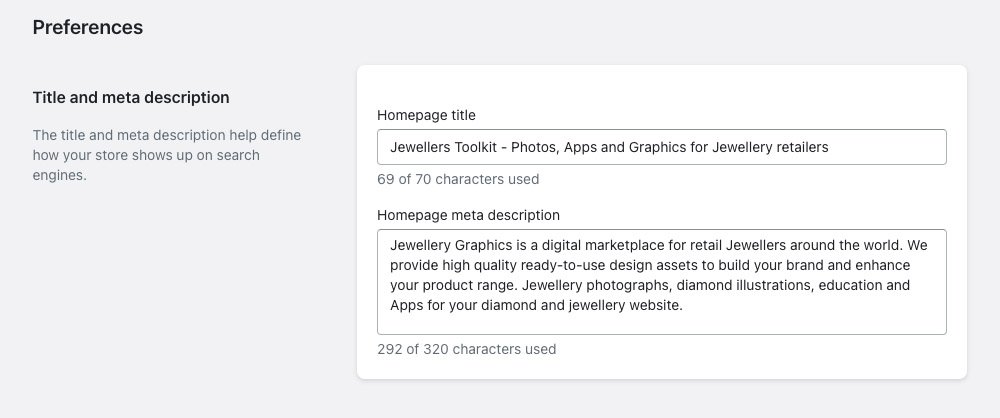
Shopify main meta information for site wide SEO. Make sure this is concise and accurate
Your homepage title should be a simple, overall, top level outline of your business. Your Homepage meta description should elaborate on this and include the keywords that make your business special. This could be important services and products. Don’t waffle, keep within the character limit and ensure accuracy.
Step3: Update your Social Sharing Image
This is important and is a good opportunity to make your brand look good when your website is shared anywhere online. If you or a customer shares a link to your website on a social sharing site such as Facebook, Linkedin or Pinterest, the link will generally display a preview image in the post. If you don’t have an image loaded it may deafult to your logo fle or the first image it finds in the page. If not formatted properly or low quality it can make social posts look less than perfect.
To update your social preview image on Shopify head to: Online store > Preferences

Add your social sharing image on Shopify to enhance your SEO

Example from Jewellery Graphics - 1200 x 628px
to expand on this, Shopify has introduced a Brand centre within your settings. You can update your brand files here to make sure your website is displayed correctly in apps or listings online or within the Shopify ecosystem. Head to Settings > Brand to update this information.
Step4: Install Google Console for Site Health
Google Search Console is an important tool for your SEO success. It is a free service offered by Google that helps you monitor, maintain, and troubleshoot your site's presence in Google Search results. Search Console helps you understand and improve how Google sees your site. Sign up for your free account at https://search.google.com/search-console/about
You will need a free GMAIL account in order to use Google Search console. If you want to maintain your business email address e.g @yourdomain.com you can sign up to Google Workspace. Lionsorbet have used Google’s business tools since our inception in 2007 and couldn’t recommend them enough for your business email.
Sign up for a free Google console account at https://search.google.com/search-console/about - Click Start now and sign in with your new or existing gmail account.
Enter your domain without the www prefix
Verify your domain ownership with your Domain registrar account
If you are unsure of how to add new records to your domain registrar contact your host and they can help you add these.
Once verified you can add your sitemaps. A sitemap helps search engines discover URLs on your site. Shopify’s sitemaps are found at yourdomain.com/sitemap.xml. If you login to Google console and click Sitemaps on the left hand side menu you can enter your sitemap here. Just add sitemap.xml to the end of the domain as shown below.
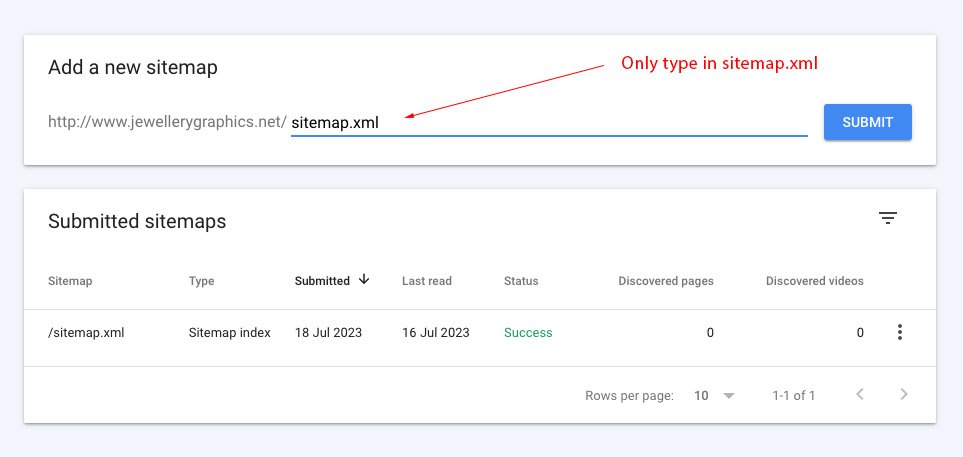
Once set up properly, Google console is an insightful tool to track your website performance, and positioning along with core web vitals. It will also highlight any issues with your website and provide insights in how to fix them.

3. Does Shopify Support SEO?
Shopify has some excellent SEO tools and features to enhance your site visibility and ensure it is indexed and ranked correctly in search engine results. These features include:
Built in SSL (Secure Socket Layer) a standard security technology for establishing an encrypted link between a server and a client.
URL optimisation: Ability to edit the URL parameters for a product or page, along with editing the URL structure to make them easier to read.
In-built 301 URL redirects to make updating URL’s much easier and useful for search. Great for website migration to Shopify from another platform .
Automatic XML sitemap generation located at /sitemap.xml for Shopify stores.
Site wide meta title and description support for the homepage and all products, pages, blogs and collections.
Responsive mobile friendly designs across all theme architecture to ensure sites are visible across all devices without the need for separate websites.
Shopify auto-generated robot txt file ( a file that helps web crawling and indexing)
Canonical tags to prevent duplicate content.
Structured data (Schema Markup), allows rich snippets to appear in Google search.
Overall, we believe it is fast becoming one of the most useful eCommerce platforms for product sales due to its amazing tool set, community driven approach and customer support.
Shopify also has some great tips for improving your SEO that will guide you through your store set up and and continued SEO success. These include:
Finding Keywords that are relevant to your brand and using them in your titles and content.
Ensure your URL’s match the content e.g https://aosdanaiona.com/pages/heritage is a page about the brands history and heritage with Celtic Jewellery.
Register your domain with Google Search Console including your full www. domain, to ensure correct site indexing.
Creating engaging and relevant content to enhance your website, increase sharing and links and to educate and inspire your audience.
4. Avoid Duplicate Pages, Products and Content
Avoiding duplicate pages, products, and content is crucial for website owners. It helps improve search engine rankings, ensuring better visibility for their site. Additionally, it provides a better user experience by avoiding confusion and frustration caused by identical content. By eliminating duplicates, website owners can protect the value of their backlinks, maintain a positive relationship with search engines to avoid penalties, and ultimately enhance their website's performance and visibility.
There are a few ways that you can reduce duplicate content in Shopify:
When duplicating products, ensure the Title is unique and the Meta Title and Description at the bottom of the page is unique for that product. We often see (Copy) in the title where products have been duplicated, and the SEO meta data is identical to the original product.
Run a duplicate content report through apps like SEM Rush or Screaming Frog which will identify and link through to duplicate pages and help you identify which are the originals and which ones need updating.
In most cases duplicate content is caused by mistake and can be rectified by updating the meta title and description and ensuring the page content is unique to that product.
The more technical side of Shopify’s URLS structure can provide a few issues with duplicate content. Because of the way Shopify organises products into collections, some themes are built to present variations to a products URL. The primary url for a Shopify product will be
yourdomain.com/products/productname an example of this is our Blog post checklist guide at
https://www.jewellerygraphics.net/products/ultimate-blog-post-checklist-for-jewellers-pdf
because the product is also in a collection it also has a URL at:
This means the wrong page can get indexed by google causing some duplicate error flags to appear. You can use Canonicalisation or redirects in Shopify to combat this but in our experience this hasn’t caused many issues and doesn’t get flagged in the pro tools we use to manage website SEO for our clients.
Meta data is an important piece of the jigsaw puzzle to ensure your SEO is in good order. Think of Meta Data as a shortened overview of the content that search engines like Google use to index and categorise the page. This shortened information is concise and informative enough to ensure that the reader knows what the article or page is about before they decide to click into a page to read about it.

Search engine results for illustrating meta titles and descriptions
When you search google for a particular term e.g “How to spot a fake Rolex?” Google will list articles in order of what they believe is the most useful and relevant to the search term. The Titles match or have relevant information about my search and the descriptions offer an insight into the article that allow me at a glance to see if it will provide the right information I am looking for.
To ensure your Meta titles and descriptions are accurate and relevant to the page content for Shopify you can update them by following these guidelines.
Shopify Product SEO Meta Data
To update your SEO Meta Data for each product, click in to a product in the Shopify Admin and scroll all the way to the bottom of the page where is says “Search Engine Listing” Click the Edit button to reveal the Page Title and Meta Description. If you have already added information to the page description at the top of the page you may find these sections have already been filled in. Check each product and ensure that not only do they have the Title and Description fields filled in, but they are also relevant, informative and easy to understand. DO this for all products on your store.

Example Meta Data panel in Shopify Products.
Shopify Collection Page SEO Meta Data
Using exactly the same method above for products, navigate to each collection in the Shopify Admin > Products > Collections. Scroll to the bottom of the collection page and click edit next to the “Search Engine Listing” section. Fill in the Page Title and Meta Description for each collection on your store. Provide information related to each collection, offering a simple, descriptive overview of the product and collection story.

Shopify Pages SEO Meta Data
Updating and managing the SEO Meta Data for each of your pages in Shopify is quite straight forward. Navigate to each page in the Shopify Admin > Online Store > pages. Scroll to the bottom of the page and click edit next to the “Search Engine Listing Preview” section. Fill in the Page Title and Meta Description for each page on your store. Provide information related to each page that matches the content of the page. Also check your URL and Handle are simple and clear and easy to link to should you need so. Do this for all pages on your website. Make them unique for each page and do not duplicate any content across your pages.

Shopify Blog Post SEO Meta Data
Updating and managing the SEO Meta Data for each of your blog posts in Shopify is quite straight forward. Navigate to each blog page in the Shopify Admin > Online Store > blog posts. Scroll to the bottom of the page and click edit next to the “Search Engine Listing Preview” section. Fill in the Page Title and Meta Description for each blog post on your store. Provide information related to each post that matches the content of the page or article. Be sure to check your URL and Handle are simple and clear and easy to link to should you need so. Do this for all blog posts on your website.
You can also edit the SEO data for your overall blog page by navigating to Admin > Online Store > blog posts and clicking on the Manage blogs button at the top of the page. You can then select your blog and edit he “Search Engine Listing Preview” blog.

6: Make Sure Your Pages Load Quickly
Fast-loading website pages are crucial for a better user experience and overall website success. Users expect quick loading times, and a slow page can lead to frustration and high bounce rates.
Faster loading enhances user satisfaction, encourages exploration of more pages, and positively impacts conversion rates. Additionally, search engines consider loading speed for ranking, leading to increased organic traffic. With the rise of mobile browsing, optimising for speed is essential for engaging mobile users. Furthermore, faster loading reduces server strain, lowering hosting costs, and improving website performance during traffic spikes.
Shopify’s platform employ some excellent built in features that make delivering a website information fast but there are a few things that you or your developers can hep with to increase overall page speed.
To optimise your website for faster load times, consider the following techniques:
Optimise Images: Compress images to reduce their file sise without significant loss of quality. Tools like ImageOptim, TinyPNG, or Squoosh can help with this. Save as JPG’s although Shopify converts to WebP images as standard.
Caching: Implement browser caching to store static resources locally on a user's device, reducing the need to re-download them on subsequent visits.
Minimise HTTP Requests: Reduce the number of elements on your page that require separate HTTP requests, such as scripts, stylesheets, and images.
Use Content Delivery Networks (CDNs): CDNs distribute your website's assets across multiple servers worldwide, ensuring that users can access them from a server close to their geographical location, reducing latency. Shopify uses a sophisticated CND network backed by Cloudflare
Optimise CSS and JavaScript: Minimise and combine CSS and JavaScript files to reduce loading times.
Prioritise Above-the-Fold Content: Load essential content first, so users can start engaging with the page while other assets load in the background. Use Lazy loading scripts on images to offset load times.
Optimise Web Fonts: Limit the number of font styles and subsets to reduce font loading time.
Reduce Redirects: Minimise the number of redirects on your website as they add extra time to the page loading process.
Monitor and Test: Regularly monitor your website's performance using tools like Google PageSpeed Insights, GTmetrix, or Pingdom. Test your website on different devices and browsers to identify areas for improvement.
By implementing these optimisation techniques, you can improve your website's loading speed, providing a better experience for your users and positively impacting your website's performance and rankings.
7: Choose Keywords That Make Sense
To keep keyword analysis simple, think of the things that your customers are more likely to use or search to find what they are looking for. Be specific and targeted. For instance if you sell ‘Ladies travel bags’ there is no point trying to rank for Bags (too vague), Women’s Bags (too loose). Travel bags would be better and Ladies or women’s travel bags are specific and to the point.
Once you have a list of Keywords that you want to target and rank for you can start to add these to your website content.
Create articles and pages with information about each keyword target.
Add the keywords to the Meta Title and Descriptions of relevant pages and products.
Add the keywords to H1 and H2 tags in relevant pages, blogs and products.
Link Keywords in blogs to specific pages and product.
My advice here is not to overthink it and just think naturally about what keywords would more likely be used in discussions and conversations. Just because a competitor uses a particular terms doesn’t mean you have to. Plain english and simple language will always prevail.
8. SEO tracking and reporting for Shopify
If you want to extend the functionality of your eCommerce analytics to provide more tracking data you can set up advanced eCommerce analytics in both Google Analytics and Shopify. Setting up Advanced eCommerce in Shopify and Google Analytics empowers you with valuable data and insights to optimise your online store, understand your customers better, and make data-driven decisions to drive growth and improve your overall e-commerce performance. Some key advantages are:
Enhanced Sales Tracking: Advanced eCommerce provides a detailed look into your customers' purchase behaviour, allowing you to track and analyse specific actions, such as product views, adding items to the cart, and completed transactions. This level of granularity helps you understand your sales funnel better and identify opportunities for improvement.
Product Performance Analysis: With Advanced eCommerce, you can assess the performance of individual products, including revenue generated, quantity sold, and conversion rates. This information enables you to identify your top-performing products and make intelligent decisions on product offerings based on actual data.
Shopping Behaviour Analysis: Understand how users navigate your Shopify store with Shopping Behaviour reports. Analyse drop-off points, see how often users abandon their carts, and identify areas for optimising the user experience to increase conversions.
Checkout Behaviour Insights: Advanced eCommerce provides checkout behaviour analysis, allowing you to monitor each step of the checkout process. Discover where customers abandon their purchases and implement improvements to reduce cart abandonment rates.
Customer Lifetime Value (CLV) Tracking: By integrating Shopify with Google Analytics, you can track CLV, helping you understand the long-term value of your customers. This data is essential for customer retention and improving profitability.
Best Performing Channels: Understand the contribution of different marketing channels to your sales e.g Facebook, Instagram, Email marketing for instance, this can provide insights into which marketing efforts are most effective, allowing you to concentrate your efforts into those that provide the best return.
Data-Driven Marketing Decisions: The combination of Advanced eCommerce in Shopify and Google Analytics provides you with data to make better marketing decisions. Use these insights to optimise your advertising campaigns, identify potential growth opportunities, and refine your overall marketing strategy.
Custom Reporting: Create custom reports and dashboards to focus on specific metrics and KPIs that matter most to your business. Tailor the data presentation to your preferences and easily share reports with stakeholders.
9: Don’t Neglect User Experience
Neglecting user experience and user interface design (UI/UX) while focusing solely on search engine optimisation (SEO) can have adverse effects for your Shopify eCommerce website. It's essential to prioritise your website design to ensure:
User Engagement: A positive user experience encourages visitors to stay longer, interact with your content, and explore more pages, which can improve SEO rankings.
Bounce Rate: Neglecting UI/UX design may lead to a high bounce rate, signaling search engines that your site might not be relevant or valuable to users, resulting in lower rankings.
Mobile-Friendliness: A responsive design is crucial as search engines prioritize mobile-friendly websites, ensuring a positive experience for mobile users and higher rankings.
Website Loading Speed: Fast-loading websites improve user experience and search engine rankings, as slow-loading sites frustrate users and discourage engagement.
Deacons Jewellers employ smart UI and navigation
So what can you do to ensure your UX design works well? We work with many creative individuals that want to break the mould and provide something different, create a unique experience and wow the their audience. You have to be careful though that you don’t confuse your audience. There is a reason nearly all Shopify websites work the same way and designed in a similar fashion. Customers get used to certain design features and this makes them feel comfortable when browsing your website. These features include:
Simple Desktop Navigation: Employing a horizontal menu below or adjacent to the company logo, with clear links and simple dropdown menus that area easy to read, simple to rollover and easy to click.
Clear Mobile Menu: Using the well know Hamburger style menu to make mobile browsing a simple task. This menu should be accessible on all pages of your website and include links to all your main collections and useful pages a customer requires to make a decision to purchase.
Breadcrumbs: These present a simple user path to the pages they are on and generally appear at the top of the page, under the main menu. These are great for nested pages, such as products, or blogs that are in specific categories and allows the under to jump back to a particular page if needed. Whereas Breadcrumbs are still important in UX design, we don’t always add them in to every website. If most site wide links are only one page deep e.g Home > Blog for instance little value is added.
Visible Search Bar: This is a highly functional tool for most Shopify websites and should be in a prominent position on both mobile and desktop versions of the website. With most modern Shopify websites you can include predictive search, that shows a list of products or pages in the search bar as you are typing to help customers easily find products. You can also add advanced features that direct specific words to pages within the website to direct traffic flow. We employed this feature in https://www.deacons-jewellers.com/ with the search term Rolex to direct to a specific Rolex Landing Page rather than the search results page.
10: Take Advantage of the Shopify Blog Function
Creating a blog is by far one of the best ways to enhance your business, boost SEO performance, build authority in your industry, drive traffic and customer engagement, whilst offering long term value and a competitive advantage to your business. Shopify has an excellent built in Blog platform that you can use to create new content, categorise to make them more searchable and organise by data and tags.
“Building a blog is one of the most important things you can do for the long term success of your business”
Steve Irvine - CEO Lionsorbet

Building a blog can drive large amount of organic traffic
Here are some simple tips to optimise your Shopify blog for SEO:
Define Your Goals and Audience: Clearly define the purpose of your blog and identify your target audience.
Write High-Quality Content: Focus on creating well-researched, valuable, and engaging content. Your blog posts should be informative, entertaining, and easy to read.
Optimise for SEO: Use relevant keywords and phrases in your blog posts to improve search engine rankings. Use descriptive titles, headings, and meta tags.
Use Visuals: Include eye-catching visuals such as images and videos to enhance your content and make it more shareable.
Promote Your Blog: Use social media and email newsletters to promote your blog and reach a wider audience.
Be consistent: Stick to a consistent schedule to keep your audience engaged and coming back for more.
Interlink Your Content: Link to relevant posts within your blog to increase the time users spend on your site and improve SEO.
Creating a great blog takes time and effort, but by staying dedicated you can build a blog that attracts and retains a loyal audience, contributes to your business goals, and establishes you as an authority in your field.
11: SEO Tools and Apps For Shopify
There are several excellent SEO tools and apps available for Shopify that can help you optimise your website and extend its search engine visibility. Here are some of the best SEO tools and apps for Shopify:
SEO Manager: Boost your Shopify SEO with this comprehensive app offering on-page optimisation, meta tag management, sitemap generation, and more. Visit https://apps.shopify.com/seo-meta-manager
Plug in SEO: Easily identify and fix SEO issues on your Shopify store with this user-friendly app providing actionable recommendations for meta tags, headings, and alt tags.
SEMrush: Optimise your Shopify store using SEMrush, an all-in-one SEO suite for keyword research, competitor analysis, backlink monitoring, and more. Visit https://www.semrush.com/
Yoast SEO for Shopify: Leverage the power of Yoast SEO specifically tailored for Shopify to optimize your store's content, meta tags, and improve search visibility.
Ahrefs: Conduct in-depth SEO analysis, competitor research, and keyword research to refine your Shopify SEO strategy using Ahrefs' powerful tools. Visit https://ahrefs.com/
Google Search Console: Integrate your Shopify store with Google Search Console to gain valuable insights into your site's performance, indexing status, and potential issues. Visit https://console.cloud.google.com/
Google Analytics by Shopify: Track website traffic, user behaviour, and sales performance by connecting your Shopify store with Google Analytics for better SEO understanding.
Smart SEO: Optimise meta tags, alt tags, and other on-page SEO elements using Smart SEO, while benefiting from bulk editing and advanced SEO features.
Crush.pics: Boost your Shopify site's speed and user experience by optimising and compressing images with Crush.pics.
AMP by Shop Sheriff: Implement Accelerated Mobile Pages (AMP) on your Shopify store with AMP by Shop Sheriff, enhancing mobile page load speed and user experience.
12. Google Shopping
Google Shopping provides eCommerce businesses with increased visibility, better engagement, and access to valuable insights, making it a cost-effective and efficient platform for driving sales. Google Shopping Benefits for Shopify eCommerce include::
Visibility Boost: Your products appear prominently in Google search results, attracting more clicks.
Visual Showcase: Eye-catching images and details offer a quick overview of your products.
Qualified Traffic: Shoppers see relevant information upfront, leading to higher-quality clicks.
Wider Reach: Extend your brand exposure on Google's shopping tab and partner sites.
Mobile-Friendly: Optimised for mobile devices, capturing mobile shoppers effectively.
Easy Management: Sync product data effortlessly through Google Merchant Center.
Insights & Analytics: Access performance data to optimize your ad campaigns.
Cost-Effective: Pay only for clicks, giving you control over your ad spend.
Ensuring your products were listed and displayed correctly on Google Shopping used to be a bit more technically challenging. Shopify recently introduced the new Google & Youtube app that not only makes the set up process easier but automates the listing of your products on Googles shopping feed. The features of the app include:
Sync your products with ease to Google Merchant Center.
Get listed free of charge automatically on Google.
Drive conversion with Buy on Google for eligible merchants.
Connect with your audience and sell on YouTube.
Expand your reach and boost sales with Performance Max.
Download the app, follow the simple set up instructions and benefit from expanding your products into Google Shopping.
13. International SEO
Simply put, if your website delivers products to different countries other than where you reside then you should consider an International SEO strategy to reach and target audiences in different countries effectively. You should consider things like:
International Keyword Research: Conduct keyword research for each target country and language. Use tools like Google Keyword Planner, SEMrush, or Ahrefs to identify relevant keywords with search volumes specific to your target regions.
Multilingual Content: Translate and optimise your website content for each target language. Avoid using automated translation tools as they may not provide accurate translations. Instead, hire professional translators to ensure high-quality and culturally appropriate content. Shopify allows you to manage multiple languages effectively within your store admin.
Shopify Markets: Implement hreflang tags in the HTML code of your Shopify website. Hreflang tags signal to search engines which language and regional content is intended for specific users, helping search engines display the right version of your pages in search results. The easiest way to set this up in Shopify is to use Shopify Markets which will allow you to easily set up countries, taxes and currencies you intend to work with.
Country-Specific Domains or Subdomains: Consider using country-specific domains e.g mydomain.fr or mydomain.jp This can help search engines identify the geographic targeting of your content more accurately.
International URL Structure: Use clear and consistent URL structures for international pages. For example, use /fr/ for French versions, /de/ for German versions, and so on. Chanel operate this method for their international stores e. https://www.chanel.com/gb/ and https://www.chanel.com/fr/
Geotargeting in Google Search Console: Set up separate Google Search Console properties for each target country. This allows you to geotarget your content to specific countries and monitor the performance of your international SEO efforts. It has been reported though that employing these methods can hurt your SEO if not tackled effectively.
Localised Customer Support: Provide localised customer support, including language-specific customer service and contact information, to enhance the user experience for international customers.
Currency and Payment Options: Offer local currency options and preferred payment methods for each target country to improve the overall user experience and increase conversions. Multi currency support is now even easier to set up in Shopify with Markets.
Local SEO Efforts: Incorporate local SEO strategies for each target region, such as creating and optimising Google My Business listings for physical store locations (if applicable) and submitting your site to local directories.
By following these steps, you can effectively employ international SEO for your Shopify website, expand your online presence in different countries, and reach a wider global audience.
14. Frequently Asked Questions FAQ’s
FAQ’s are a powerful way to add lots of relevant information to your website on product pages, blog posts and service pages to answer specific questions about your business.
“Every question your website leaves unanswered is an opportunity for a competitor to answer it.”
Steve Irvine - CEO Lionsorbet
We use these in two ways. Firstly any question a client asks us about a product or service of ours, we will answer and the add to our website FAQ’s in the right area. For instance check our FAQ’s for our Diamond Ring Builder APP (scroll to the bottom of the page), we update this regularly with client questions and requests. Secondly if you head over to websites like Answer the Public and Also Asked and enter a question about a particular service or topic you sell, they will list all of the questions and information people on the internet are searching for. This literally gives you a wealth of information to start compiling answers too and adding to your website.
Shopify SEO FAQ’s
Is Shopify good for SEO?
Yes. Shopify provides a strong foundation for SEO and gives you control over the important elements including page titles, meta descriptions, headings, image alt text, redirects, products, collections and content.
We've worked with Shopify stores for over a decade and have seen excellent organic search performance across businesses of very different sizes. The platform is rarely the thing holding a website back. What you do with it matters far more.
Do I need an SEO app for Shopify?
No. You can implement good SEO on Shopify without installing an SEO app.
Apps can help identify problems, manage certain repetitive tasks or provide additional functionality, but installing one won't automatically improve your rankings. Before adding another app, understand what problem you're trying to solve. If you don't need it, don't install it.
How do you improve SEO on a Shopify store?
Start with the areas that have the greatest commercial value.
Make sure your website structure is logical, your important collections and products contain useful information, page titles and headings clearly describe the content, images are properly optimised and your website is technically accessible to search engines.
Then create genuinely useful content around the questions your customers are actually asking. Don't try to do everything at once. Identify the pages most important to your business, improve those first and measure the results.
Conclusion
We've worked with Shopify for over a decade and built hundreds of websites during that time. One thing hasn't really changed: good SEO is less about the platform and more about what you do with it.
A good guitarist can make a cheap guitar sound great. A talented painter doesn't need the most expensive canvas. Shopify gives you the tools, but it's how you use them that makes the difference.
I tend to think about SEO using the 80/20 rule. A relatively small number of improvements will usually have a much greater impact than endlessly working through technical SEO checklists.
Get the important things right first:
Create genuinely useful content
Build strong product and collection pages
Use excellent photography and video
Earn genuine customer reviews
Make your website easy to navigate
Give customers a great experience
Technical SEO matters, but I still think of much of it as the icing on the cake. If what's underneath isn't very good, adding more icing isn't going to fix it.
So don't finish this guide with a list of 50 things you intend to do. Pick the three things that would make the biggest difference to your Shopify store and start with those. Then measure what happens.

Not sure what's holding your website back?
Our Ecommerce Growth Review takes an independent look at your website, customer journey and wider digital strategy to identify what we'd prioritise and where we'd invest next.

Why Jewellery Websites Don’t Convert - Even When They Look Good
Getting traffic is only half the job
If your jewellery website is attracting visitors but they aren’t buying, booking appointments or making enquiries, getting more traffic isn’t necessarily the answer.
Before spending more on SEO, advertising or social media, look at what happens to the customers you already have.
“Ecommerce success isn’t just about attracting more visitors. It’s about giving the right customers the confidence and information they need to take the next step.”
Steve Irvine - CEO Lionsorbet
What is a good conversion rate for a jewellery website?
There isn’t one.
Conversion rate is simply the percentage of website sessions that result in an order:
Conversion rate = orders ÷ website sessions × 100
So 20 orders from 2,000 sessions is a conversion rate of 1%.
Industry benchmarks can be useful, but comparing a website selling £50 earrings with one selling £10,000 engagement rings isn't particularly meaningful.
For many jewellers, an appointment, enquiry or store visit can be just as valuable as an online order.
Don't obsess over somebody else's benchmark. Work out what a valuable conversion means for your business.
Here are five things I would look at first.
1. Are you attracting the right customers?
More traffic doesn't automatically mean more sales.
If thousands of people arrive looking for information but have no intention of buying, your traffic can increase while your conversion rate falls.
Look at:
Which pages attract the most visitors?
Which pages actually generate sales, enquiries or appointments?
Which countries are visitors coming from?
Which channels produce customers rather than simply traffic?
Are old articles attracting lots of irrelevant visitors?
Someone searching “how much should I spend on an engagement ring?” may be researching. Someone searching “diamond engagement rings Birmingham” is potentially much closer to buying.
Both visitors have value, but they aren't equal.
WHAT TO DO
✓
Start with the traffic you already have
Use Google Analytics, Search Console and Shopify to identify where your sales and enquiries actually come from.
If traffic is growing but sales aren't, don't immediately spend money attracting more visitors. Find out which pages and traffic sources are generating customers first, then focus your efforts there.
2. Do customers trust you enough to buy?
You're potentially asking someone who has never met you to spend thousands of pounds online.
Your website needs to answer some very basic questions:
Who are you? Can I trust you? Is the jewellery genuine? What happens if something goes wrong?
For a jewellery business, that means making things such as these easy to find:
Real information about your business and people
Store and workshop photography
Independent customer reviews
Diamond and gemstone certification
Hallmarking and provenance
Authorised retailer status where relevant
Professional memberships
Delivery and returns
Resizing
Warranties and aftercare
Clear contact information
If you've been trading for 50 years, say so. If you're a qualified gemmologist, tell people. If customers can visit your store, show them what it looks like.
EASILY FIXED?
✓
Look at your website like a customer
Go through your website pretending you've never heard of your business.
Ask yourself: Would I comfortably spend £5,000 with this company based entirely on what I can see here?
If the answer isn't an immediate yes, identify what's missing and fix those things first.
3. Are your products giving customers enough reason to buy?
This is one of the biggest missed opportunities I see on jewellery websites.
A retailer spends money getting someone onto the website and then presents them with one manufacturer photograph, a product name, a price and two lines of description.
If five jewellers sell the same product using exactly the same imagery and description, why should the customer buy it from you?
Consider adding:
Your own product photography
Lifestyle photography
Close-up details
Video or 360° imagery
Images showing scale
Useful product descriptions
Metal and gemstone specifications
Dimensions and weights
Ring sizing
Certification
Availability and delivery times
Resizing information
Finance options
You don't need everything on every product. Give customers the information they need to make a confident decision.
EASILY FIXED?
✓
Start with your most important products
Don't try to update 5,000 products at once.
Start with your 20 best sellers or most commercially important products. Improve the photography, information and presentation, publish the changes, then move onto the next 20.
4. Are you giving customers a reason to come back?
Someone looking at a £5,000 engagement ring may not buy on their first visit.
That's normal.
The important question is whether you've made it easy for them to continue the relationship.
Useful options include:
Wishlists
Email sign-up
Abandoned checkout emails
Back-in-stock notifications
Appointment booking
WhatsApp or live chat
Recently viewed products
Useful follow-up emails
Retargeting
The objective isn't to bombard people with marketing. It's to make it easy for an interested customer to find you again when they're ready.
EASILY FIXED?
✓
Give customers a way to stay connected
Pick one or two ways for customers to stay connected.
If you don't have abandoned checkout emails running, start there. If appointments are important to your business, make booking one obvious. If customers regularly browse before buying, consider wishlists.
You don't need ten new marketing tools.
5. Is your website making buying unnecessarily difficult?
Some of the most expensive ecommerce problems are surprisingly small.
A customer can't find their ring size.
Search doesn't return the product they're looking for.
Filters are confusing.
Delivery information is hidden.
They want to see a £10,000 ring but can't find the appointment button.
Every unnecessary obstacle gives someone another opportunity to leave.
Ask:
Can customers easily find products?
Can they understand what they're buying?
Are sizing, delivery and returns obvious?
Is the next step clear?
Does search actually work?
Can someone easily book an appointment or contact you?
Have you actually tried buying something on your own website from a phone recently?
EASILY FIXED?
✓
Watch someone use your website
Give someone who doesn't regularly use your website a simple task, such as finding a platinum engagement ring under £5,000 and adding it to their basket, or finding out whether a ring can be resized and booking an appointment to see it.
Then watch them do it. Don't help them.
You'll quickly discover things that are obvious to you, but aren't obvious to your customers.
So, why isn't your jewellery website converting?
Don't immediately assume you need more traffic, a new website or a bigger marketing budget.
Start here:
1. Are you attracting the right customers?
2. Do they trust you?
3. Are your products presented properly?
4. Can interested customers easily come back?
5. Is anything making buying unnecessarily difficult?
Fix the obvious problems first and measure what happens.
For jewellery businesses, remember that the next step isn't always an online purchase. It might be an appointment, enquiry, phone call or store visit.
The goal isn't to chase somebody else's conversion rate. It's to make your website work harder for your business.
Not sure what's holding your website back?
Our Ecommerce Growth Review takes an independent look at your website, customer journey and wider digital strategy to identify what we'd prioritise and where we'd invest next.

“Why Not Just Use Wix?” And Other Questions That Aren’t Really About Websites
Why not Wix? When customers ask why they should choose an agency over a free template, the real question is about trust, strategy, and growth, not just design.
Read More
Why Your Content Isn’t Converting (And What to Do About It)
Many independent jewellers and luxury retailers are still creating content that looks great but doesn’t convert. In this article, we break down why traditional blog posts and generic newsletters are falling short — and what kind of content actually drives leads and sales. From SEO to email strategy, we share how Lionsorbet is evolving our approach to help brands like yours turn content into consistent revenue.
Read More
Top 10 Luxury Makeup & Beauty Websites in 2025
In 2025, the beauty industry is more competitive than ever and increasingly reliant of digital platforms. With global cosmetic sales continuing to soar, beauty brands are stepping up not just with innovative products, but with immersive, high-end online experiences that reflect their identity and values. A stunning website is no longer optional it's a powerful tool that drives engagement, builds loyalty, and converts visitors into devoted customers.
Read More
Jewellery Website Design: 8 Expert Tips to Boost Sales and Performance
Is your jewellery website doing your brand justice, or holding it back?
At Lionsorbet, we’ve worked with jewellers of all shapes and sizes, and one thing is clear: a beautifully designed, high-performing website can transform your online business. Whether you're just starting out or looking to improve your existing store, there are key areas that can make a big difference.
With years of experience designing Shopify websites for luxury and jewellery brands, we've learned what truly works, and what doesn’t. In this post, we’re sharing 8 practical ways to improve your website’s performance and create a more impactful experience for your customers.
Read More
Why Live Social Shopping is the Future of Retail - Can Luxury Brands Afford to Wait?
Shopping habits are evolving rapidly, and as we approach 2025, live social shopping is emerging as a game-changer for luxury retailers. By blending entertainment, social interaction, and eCommerce, live shopping offers a dynamic way to engage customers and boost sales.
Read More
Top 20 Jewellery Website Designs 2025
Welcome to 2025, come with us through our top 20 jewellery and watch website designs. Which are setting the standard with captivating design, cinematic photography, distinctive typography, and considered user experiences. Among them we’ve also highlighted some of our own creations, showcasing the expertise of our in-house team and the exceptional brands we collaborate with.
At Lionsorbet, we understand what makes a jewellery and watch website truly stand out. The brands featured on this list inspire us to push boundaries, stay ahead of industry trends, and craft visually stunning, high-performing websites.
Read More
Does SEO Actually Work?
Strategic SEO can double your traffic and drive sales
Many companies I speak to wonder if SEO is worth the time, effort, and investment. Many have had bad experiences in the past and little or no results.
It’s a fair question. After all, the results aren’t always immediate, and not every campaign delivers the same outcomes.
Read More
Global expansion made easy with Shopify Markets
Reach international customers and scale easily with Shopify. Revolutionary for Luxury Brands in eCommerce.
Selling luxury products in countries other than your own is no longer reserved for big corporations, high profile designers or celebrities, Even smaller luxury brands can now reach customers around the globe. Shopify Markets is a new feature that makes expanding into international markets much easier, helping brands manage everything from one place. We no longer have to set up seperate websites under different domains to manage international sales.
Read More
Top 20 Lifestyle Website Designs 2025
Lifestyle brands have taken 2025 by storm and we want to share with you what we consider to have the best websites. These brands have been chosen as we feel like they are setting the standard for captivating design, mobile forward designs and considered user experience.
Read More
Is the Era of Traditional Search Engines Over?
The Future of Retail: Preparing your Luxury Brand for AI & SearchGPT
Is Search Dead? With the landscape of search and consumer behavior shifting dramatically there’s a good chance it will change dramatically over the next year or so. For Generation Alpha, the idea of a traditional search engine may become a relic of the past, an obscure concept they’ll barely recognise. It’s evident that teenagers today are influencing their parents to transition from conventional platforms like Google to more interactive tools like ChatGPT. This change is just the beginning, and it poses critical questions for the future of retail.
Read More
Jewellery Website Design: Elevate Your Online Presence with a Specialist Touch
Why Jewellery Website Design Matters
In jewellery design and retail, every detail matters, from the precision of a diamond cut to the correct setting for a mount. Your website should be no different. It’s more than just a digital storefront; it’s a reflection of your brand, your craftsmanship, and the story behind each piece you create.
A beautiful jewellery website design doesn’t just attract attention, it captivates. It turns visitors into loyal customers, showcasing your collection with elegance and ease. Having a website as exquisite as your jewellery is no longer a luxury, it’s essential.
At Lionsorbet, we specialise in creating breathtaking eCommerce experiences for jewellers, where luxury meets usability. Whether you’re an independent designer or a large retailer, our bespoke Shopify websites are crafted to elevate your brand and drive real results.
Read More
Omnichannel Marketing Discussion - Jen Marsden - CMJ, Jack Allum - Allum & Sidaway, Steve Irvine - Lionsorbet and Pradip Sarda - Watcho
Omni Channel Marketing for Luxury Brands
Omni means a combining form, meaning ‘ALL’. Therefore the term ‘Omnichannel marketing’ ensures that your customers have a seamless and consistent experience across all platforms, whether they’re shopping online, mobile, in-store, or engaging with your brand on social media. It’s effective because it puts the customer at the center, meeting them wherever they are and making their journey smoother, which leads to higher engagement, better brand loyalty, and increased sales. Customers expect a connected experience, and brands that deliver it will stand out.
Read More
Boost Your Content's Visibility with One Simple Trick!
Use Internal Linking to build authority and increase website traffic
Did you know that by 🔗 Linking older pages or blogs to your new content, helps search engines find and rank it faster?
This SEO strategy is called ‘Internal Linking’ and it’s a simple way to boost visibility in search, as it shows that your latest work is important and connected to what you've already published.
This practise not only helps your content get noticed quicker but also strengthens your website’s overall performance. 🚀
Read More